
Do You Need a Yoga Strap? A Teacher's Honest Take
Short answer: yes, for most people, at least some of the time. A strap is not a crutch and it is not proof that you are inflexible. It is a way to extend your reach so your hands, or a bind, can meet fabric instead of empty air. Once you understand what it is actually doing, it stops feeling like a beginner's tool and starts feeling like any other prop: something that lets you work a pose properly instead of faking the shape.
What a strap actually does
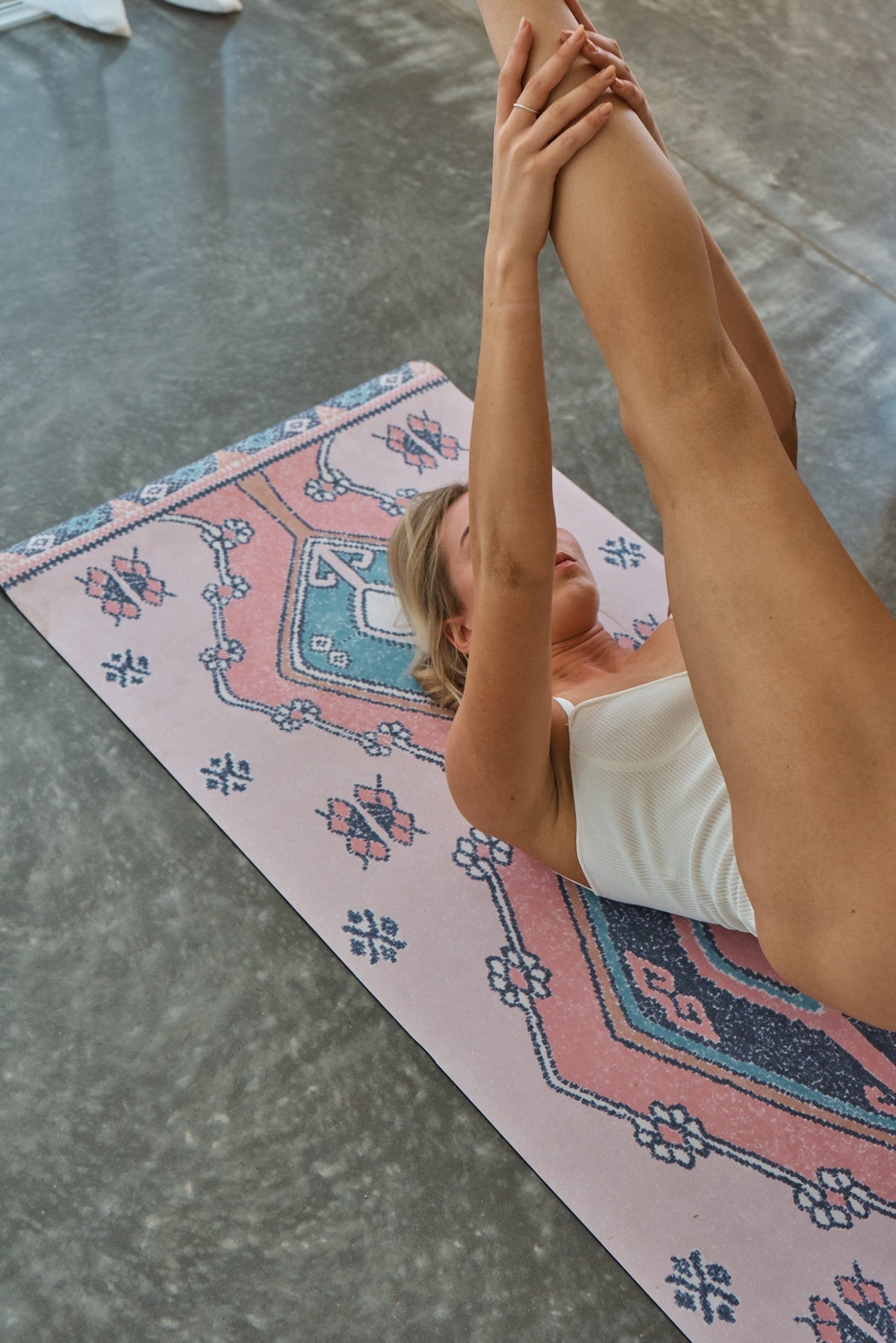
Picture a seated forward fold. If your hamstrings are tight, your hands might land somewhere around your shins, and to reach further you round your spine and yank yourself forward. That is not a deeper stretch, it is just poor mechanics, and over time it puts the strain in your lower back instead of the backs of your legs where it belongs. Loop a strap around the balls of your feet instead, hold the ends, and you can keep your spine long while your arms do the reaching. The stretch happens in the right place.
The same logic applies to binds. In poses like cow face pose, your hands are meant to clasp behind your back, one reaching over the shoulder and one up from below. Most people's shoulders are not ready for that on day one, and that is completely normal. A strap bridges the gap so you get the shape and the shoulder opening without straining to force a connection that is not there yet. It shows up in plenty of other poses too: bound side angle, extended hand to big toe pose, even bridge pose when you want to keep your arms straight and clasped underneath you.
Who gets the most out of one
If you are newer to yoga, a strap earns its keep in almost every class. Tight hamstrings, stiff shoulders, and a spine that has not learned to fold yet are all completely normal, and a strap lets you practice the correct pattern while your body catches up in its own time.
It is also useful if you are returning to the mat after time off, rebuilding mobility, or working around an old injury that is limiting your range for now. And experienced practitioners keep one nearby too. Shoulders tighten up after a day hunched over a desk, hips get grumpy after a long drive, and a strap is a quick way to keep working the full pose on a day when your body is not cooperating.
If you have been practicing consistently for a while and your hands already meet behind your back, or your palms reach your feet without effort, you probably do not need one for those particular poses anymore. That is a sign of progress, not a reason to feel smug about it. Flexibility changes day to day depending on sleep, stress, and how much you have been sitting, so do not be surprised if you reach for the strap again after a stiff morning even months into a regular practice.
Using it without cheating the stretch
The point of a strap is to let you hold a correct shape, not to help you fake a bigger one. Grip it wide enough that your shoulders stay relaxed, and only shorten your hold as your body genuinely opens up, not because you are trying to look more advanced than you feel. If you are gritting your teeth or holding your breath to close the gap, the strap is too short and you are working against yourself.
Breath is the real test. In any pose that uses a strap, whether it is a hamstring stretch, a shoulder bind, or something from a class focused on tight hips and hamstrings, you should be able to breathe slowly and evenly the whole way through. If you cannot, back off the grip until you can. The stretch is still working even when it looks less impressive from the outside, and it is doing more for you than a version you have muscled your way into.
One more thing worth getting right: keep some tension in the strap rather than letting it go slack. A loose strap does nothing, and a strap held in a death grip just tires out your hands and forearms instead of letting your target muscles do the work. Aim for a steady, even pull, the same way you would hold a rope you are gently leaning back against.
Buying one, or making do
A proper yoga strap is just cotton or nylon webbing with a buckle, usually somewhere between 1.5 and 2.5 metres long. Cotton has a bit more texture and grip, nylon is a touch more slippery but very durable and easy to wipe down. Either works fine for a home practice, and the length is more a matter of your height and how you like to loop it than anything else.
You do not strictly need to buy one to get started. A dressing gown tie, a long scarf, or even a belt can stand in while you work out whether this is a prop you will use often. Once you know you will reach for it regularly, though, a proper strap with a secure buckle is worth having. It will not slip mid-pose the way a makeshift version sometimes will, and the buckle lets you adjust your grip precisely instead of guessing at where to hold a knotted scarf.
If you are building out a small home practice space, a strap is one of the cheaper and more useful additions you can make alongside our mats. It takes up almost no room, it works across every style of yoga rather than one in particular, and it means you are never skipping a pose just because your hands cannot quite meet.

Comments